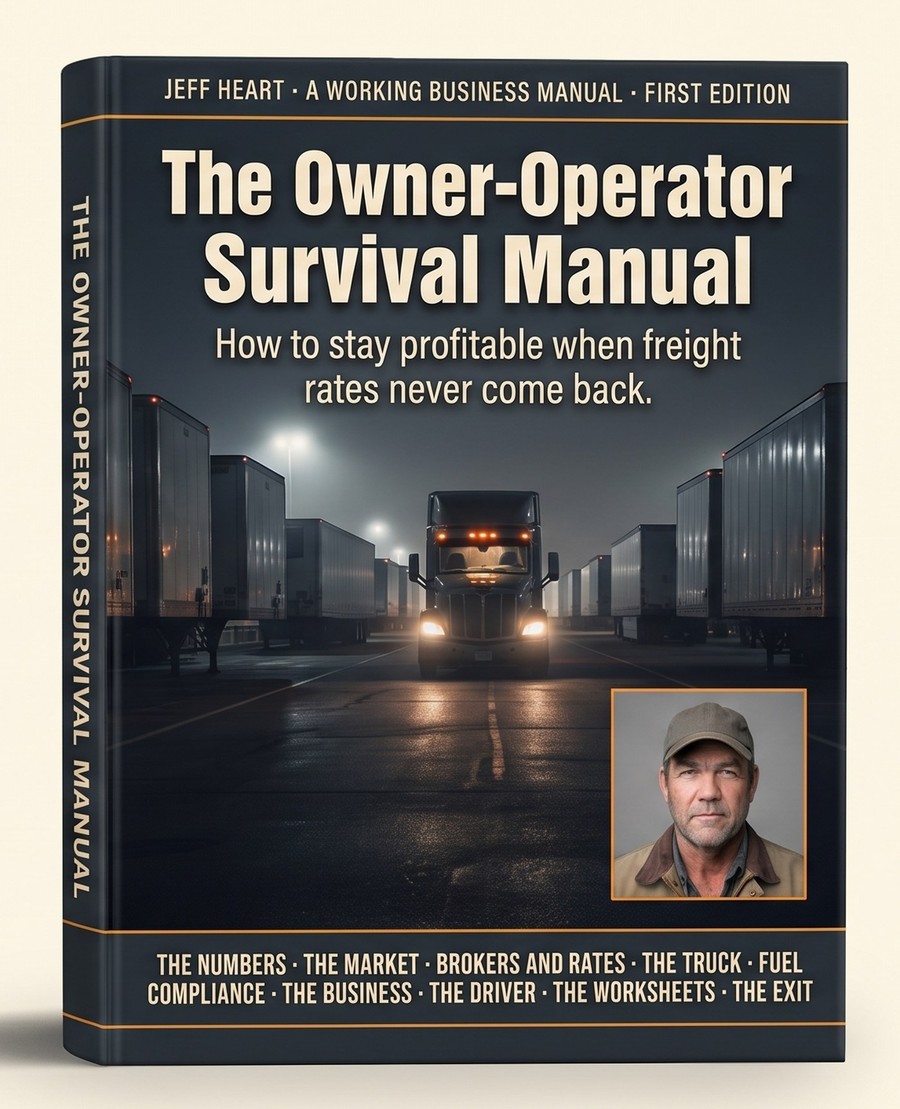
They ran eighteen months of slightly unprofitable miles without knowing the miles were unprofitable — then a transmission went out and the whole thing came down at once. The transmission gets blamed. The eighteen months did it.
Instant download · Yours forever

“A rate is not high or low in the abstract. It is high or low against your number.”
Chapter 01 — What A Mile Actually Costs You
There is nothing in here about loving the open road. You already know whether you love it. What you may not know is exactly what your truck costs you every time the wheels turn — and that single missing number is what ends most one-truck operations.
You are going to hear two stories about this market and both of them are partly true. The headline story is that freight came back. That is real. Spot rates through the first half of 2026 have run thirty to forty-five percent above where they sat in 2025, and for the first time since early 2022 spot crossed above contract.
The story underneath is that your costs came back too, and they came back faster. The American Transportation Research Institute put the industry-average cost of operating a truck at $2.336 per mile for 2025 — the highest figure in the history of that report. Strip fuel out and costs still rose 4.2 percent, well ahead of inflation.
Some of what is in this book comes from videos I have posted. Most of it goes further than the videos ever could, because a video has to hold your attention and a book only has to be right. A few chapters are things I have never put on camera at all, because they take twenty pages to explain properly and nobody watches a twenty-page video.
Every figure in the right-hand column comes from the book's worked example: a used sleeper, dry van, its own authority, one driver, 110,000 miles a year.
Read it in any order — go straight to whichever part of the operation is bleeding. But if you read only one part, read Part One. Everything after it assumes you know your cost per mile.
Instant download · Yours forever
I did the cost-per-mile worksheet on a Sunday and sat there looking at it. I had been running two lanes all year that were under my floor. I thought they were my good lanes because the checks were big. The checks were big because the miles were long.
Dale R.Dry van · one truck · Ohio
Chapter 11 is the one. I stopped asking what it pays first. Four calls later a broker came up thirty cents on a Laredo run without me ever naming a number. That paid for the book about forty times over.
Marcus T.Reefer · own authority · Texas
The broker vetting sheet caught one for me in the second week. Brand new outfit, phone number did not match the FMCSA record. I passed on the load. Heard later that three carriers did not get paid on it.
Ronnie K.Flatbed · leased on · Georgia

I have spent my working life around one-truck operations — mine and other people's. The videos I post are the short version: the thing you can explain in eight minutes at a fuel island. This book is the long version.
Every chapter here follows the same shape, because a repeated shape is easier to use at a truck stop at midnight than a clever one. What the problem is and roughly what it costs. The working section, walked through the way one driver explains something to another across a table. What the method does not do — because everything in trucking has a limit, and the people selling you things will not tell you where theirs is. Then the arithmetic: what it costs to start, what it puts back in your pocket, and how long it takes.
Where a number matters I give you the number and where it came from, with the year attached, so you can tell how stale it has gotten by the time you read this. And I will tell you plainly what this book is not. It is not a promise that you will make money. What a book can do is show you the numbers early enough to act on them.
Instant download · Yours forever
No. Some of what is in the book comes from videos I have posted, and I say so where it does. Most of it goes further than the videos ever could, because a video has to hold your attention and a book only has to be right. Several chapters — the DOT audit walkthrough, the tax chapter, the exit chapter — have never been on camera at all, because they take twenty pages to explain properly and nobody watches a twenty-page video.
Because the free version has to be short. A video can tell you that your cost per mile matters. It cannot sit with you for two hours while you build the number out of twelve months of your own settlement statements, and it cannot be open on the passenger seat while you do it. That is what the worksheets in the back are for.
The other reason is order. The book is built so that Part One holds up everything after it. On a channel you get chapters in whatever order I happened to film them.
Because of who I want reading it. The drivers who need Part One most are the ones running eighteen months of unprofitable miles right now, and they are not in a position to spend two hundred dollars on a maybe. Twenty-seven dollars is under six gallons of diesel. If the book is worth anything at all, it clears that on the first load you price properly — and if it is not, I would rather you found that out cheap.
The numbers are worked on one truck on purpose — a used sleeper, dry van, own authority, about 110,000 miles a year of which 100,000 are paid. I had to pick something, and a worked example you can follow all the way through is worth more than a page of ranges.
Your truck is not that truck. Substitute your own figures everywhere; the worksheets at the back are built for exactly that. The method is what transfers, not my fuel bill.
Yes, with one exception. Parts One, Five, Six, Seven and Nine apply to you unchanged — your cost per mile, your fuel, your truck, your compliance and your body do not care who your authority belongs to. The broker chapters are less use while you are leased on. Chapter 33 is the one that compares the two arrangements honestly, including the case for staying leased.
A PDF, delivered the moment you buy through Gumroad. It reads on a phone in a sleeper, on a tablet, or on a laptop, and it prints if you would rather have the worksheets on paper — most people print the five worksheets and leave the rest on the phone. Instant download, and it is yours to keep.
No. It is general business, operational and regulatory information for commercial motor carriers, written by a driver, not a lawyer or a CPA. Where a subject touches the law — your authority, your taxes, your insurance, an audit — I tell you what generally applies and where the lines are, and then I tell you to verify it with FMCSA, your state agency, or a professional who is accountable for the answer. Regulations change and vary by jurisdiction.
That is what the manual costs. One load priced properly against your own floor pays for it several times over — and Part One is the part that tells you what your floor actually is.
Get the Manual — $47 $27 or see what's inside →